Wedding lighting 2026: warm light, illuminated furniture, photogenic spaces
How a wedding lighting plan is built from reception to dance floor: colour temperature, blue hour, cable-free illuminated furniture and the venue questions.
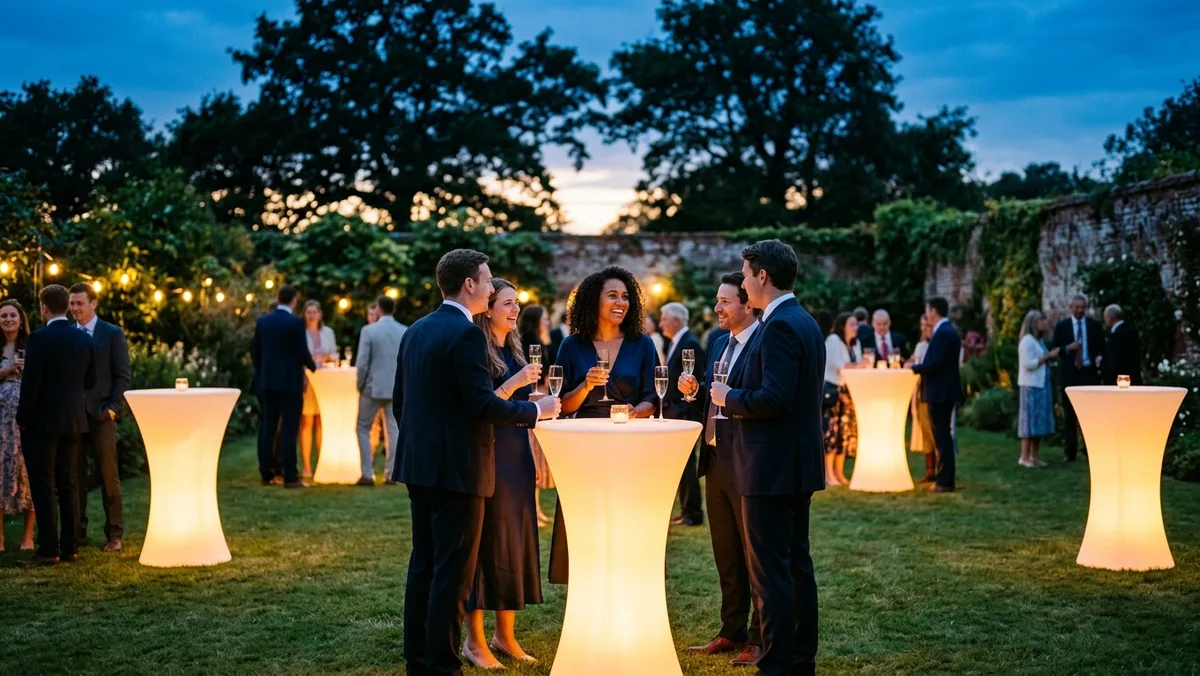
A wedding lighting plan is a harder task than lighting a restaurant because you do not have to get one state right but four, one after another, in the same space. In the afternoon there is natural light, the sun is still up during the ceremony, it goes down for the reception, dinner calls for a warm, calm picture, and after midnight exactly the opposite. And somebody is photographing throughout: the photographer, the videographer and eighty phones. If you leave the lighting to whatever the venue happens to have, there is a good chance of ending up with a mix of cold white hall lighting and a yellow garden floodlight, and that shows far more in the pictures than it does in the room. What follows is not a list of luminaire types but the way of thinking that fits the light to the schedule of the day - and it also shows where the furniture takes over the job from the lighting.
The four lighting phases that follow one another at a wedding
The first phase is the ceremony. There is usually still natural light here, and the task is more to keep hard sun off the couple's faces - which you solve with orientation and the choice of time, not with a lamp. The second is the reception: the couple go off to be photographed, the guests are left with a glass in hand, and this is when you need to create points in the space worth standing at. The third is dinner, where the job of the light is to fall on the table and on faces, not on the ceiling. The fourth is the dancing, where light no longer conveys information but energy. If you take these four phases separately, it is immediately clear that you do not need everything everywhere: a few strong points are enough in the reception area, an even, warm base light over the dinner tables, and something that moves over the dance floor. The most common planning mistake is looking for a single setting to cover all four, and ending up with none of them working. It is worth writing these four phases on a sheet of paper, a time next to each, and naming who touches the switch at the transitions. That one line has saved more weddings than any choice of equipment: if nobody is named to make the change and to say when, nobody will do it, and the room at midnight will look exactly as it did over the soup.
Colour temperature: why not to mix five different whites
Colour temperature is measured in Kelvin, and in practice it tells you how yellowish or bluish a white light is. The warm, candle-like range is roughly 2700-3000 K, neutral white is around 4000 K, and daylight is 5500-6500 K. At a wedding the warm range almost always works in the dinner and reception areas: it flatters skin tones and it slows things down, which is exactly what an evening needs. Trouble does not come from choosing warmer or cooler light but from mixing the two in one space. If the chandelier is 2700 K, the hired spot 4000 K, the terrace floodlight 6000 K and the photographer's flash something else again, then there is no single white balance setting that will fix them all: one surface or another will always stay greenish or bluish. The first rule of a good lighting plan is therefore not quantity but uniformity - decide first what white you are using, then carry it through everything that is lit continuously.
What the photographer sees, and what the guest sees
The eye adapts mercilessly well: a room that looks pleasant in person can look muddled on camera. The reverse is true too - a technically correct setup can look sterile in person. That is why it is worth going through three things with the photographer at the site visit. The first is the colour of the light sources, because that determines their white balance. The second is where there will be strong, point-like lights in the background - a floodlight facing the camera behind the dance floor burns into every portrait. The third is the range of brightness: if one half of the room is dark and the other lit, the camera has to choose, and one of them will be lost. Illuminated furniture is a rewarding element here because it does not appear in the picture as a point light source but as a lit surface. It does not shine into the lens; it gives shape, and the face of a guest standing behind it does not become a blacked-out silhouette.
Blue hour: the twenty minutes worth rewriting the schedule for
After sunset there is a period when the sun has gone but the sky is still deep blue rather than black. Depending on the season this is twenty to forty minutes, and it is the only time when artificial light and the natural background are equals: the lamps that are on and the lit surfaces show, but the sky still draws. Anyone who wants a group photograph, a picture of the couple or a wide shot of the venue has to time it for this. In practice that means it is worth fitting the dinner schedule around it rather than the other way round: if the soup lands exactly on blue hour, you have lost those twenty minutes. Ask the master of ceremonies to leave the half hour after sunset free, and have the illuminated elements switched on and in place by then. After that comes real darkness, when only what you bring into the space counts. A practical trick: if outdoor photographs of the couple are planned, it is worth putting two or three illuminated pieces out into the chosen background in the afternoon, so that nothing has to be carried in the dark and everything is in place when blue hour arrives. Most of the guests' phone pictures are taken in this period too, so the background works twice: once for the photographer and once for social media.
Where cable-free, battery-powered illuminated furniture helps
Illuminated furniture differs from a lamp in that it does not light something up - it is itself the bright surface the guest walks over to. In our range that means 45 battery-powered pieces and 23 ready-made sets: cocktail tables, dining tables, chairs, armchairs, sofas, bar counters, stools and relax loungers. The body is polyethylene, IP54 rated, the colour switches by remote control between seven shades, and one charge gives 6-8 hours of light according to the manufacturer, depending on the colour chosen. At a wedding this helps at three points. During the reception the company arranges itself around the high, roughly 110 cm cocktail tables by itself rather than bunching up at the entrance. At dinner the illuminated top gives the base light on the table, with the candles and the flowers sitting on top of it. Beside the dancing, a lounge corner and a counter mean that anyone catching their breath does not leave the room. And because the colour switches by remote, the whole room turns from the warm picture of dinner to the livelier picture of the party all at once, with no new hired props.
Garden reception, marquee, lakeside: where there is nowhere to take power from
A good many outdoor wedding venues were not built for events: a manor park, a press-house courtyard, a lakeside meadow or a large private garden. Power is the bottleneck there, and the usual answer is a generator and tens of metres of cable, then covered with matting under the guests' feet. That is noisy, expensive, and does no good to the train of a wedding dress. With battery-powered furniture that whole round is avoided: the piece goes where the flow of guests requires, not where there is a socket. Weather is the other constant question - the IP54 rating protects against splashing water, so a summer shower, morning dew and spilt champagne will carry nothing off, and you will not find soaked upholstery in the morning. What it will not take is sustained flooding, so even at a lakeside its place is on the bank. On fresh, soft lawn look for a level spot, because all furniture sinks in there, and high tables are the first to tip on a slope.
What illuminated furniture cannot do - and what needs a LED wall
One misunderstanding is important to avoid: illuminated furniture is not a display. It gives even, single-colour light, it has no image surface, so a monogram, lettering or a projected animation cannot be shown on it. If you want the couple's monogram behind the ceremony, a menu and a toast text for dinner, and moving visuals for the dancing, that calls for a LED wall, and the two sit together perfectly well on the same floor. For that we hire out 64 × 192 cm portrait LED poster panels, linked from one to five panels; there is a list price for the indoor P2 version, HUF 30,000 + VAT per panel per day, while the other versions are quoted individually. In practice their roles are sharply separated at most weddings: the wall carries the information and the image, and the furniture organises the space and sets the mood.
Ten questions for the venue before you sign the contract
Most of a lighting plan is settled at the site visit, not on Pinterest. Ask how controllable the light is in the room: is there a dimmer, can the hall lighting be switched off separately, or is it all or nothing. Ask what colour the existing lighting is, because everything you bring has to be matched to it. Find out who switches the garden and facade lights on, and at what time - in many places this runs on a timer and goes off by itself at midnight. Look at how many sockets there are and where; ask whether there is separately metered power in the outdoor area. Agree when you can load in and by when you have to clear out, because that determines whether the pieces can be charged and laid out the day before. Ask whether the venue has its own lighting technician, and what the house rules allow to be fixed to walls, trees and ceilings. Ask how steep the ground in the outdoor area is and what its surface is, because that determines what can be set up stably. Finally, ask where the reception moves to in the wet-weather plan, because a lighting plan needs two versions, not one - and the second usually has to be made to work on the day itself, within two hours. If you write the answers down, the result is a half-page sheet that the master of ceremonies and the photographer can both read.
The lighting plan for an 80-guest wedding, in numbers
Practical sizing for a wedding of eighty. For the reception after the ceremony, 12-15 high tables is realistic, because 3-4 guests stand comfortably around a Ø80 cm cocktail table but never everyone is at a table at once. For dinner, count 4-5 place settings per Ø100 cm table, so 16-20 tables seat the company. Two or three lounge suites should go beside the dance floor, each with 3-5 resting places, and a counter in the corner. Watch the proportions of the space too: the furniture takes up 20-30 per cent of the floor and the rest should stay free for dancing and for service. The pricing rule is simple: one day's hire is 20 per cent of the gross sale price. A standing table with an ice bucket is HUF 160,000 incl. VAT, so HUF 32,000 a day; a Ø80 cm illuminated cocktail table is HUF 220,000 incl. VAT, so HUF 44,000 a day; and the cocktail reception package of three tables and six high stools is HUF 766,650 incl. VAT, so HUF 153,300 a day. In a ready-made set the basis is 5 per cent better than the members' list prices, and that shows in the daily rate too. For several days and larger configurations we give an itemised, individual quotation.
A few questions and you get the recommended pixel pitch, the size and an indicative price.
Start the configurator →


