Lighting an outdoor event: what stands up to rain, wind and the evening chill
At an outdoor event IP54, weight and the battery decide. What illuminated furniture takes in rain and wind, and when power still has to be brought to the site.
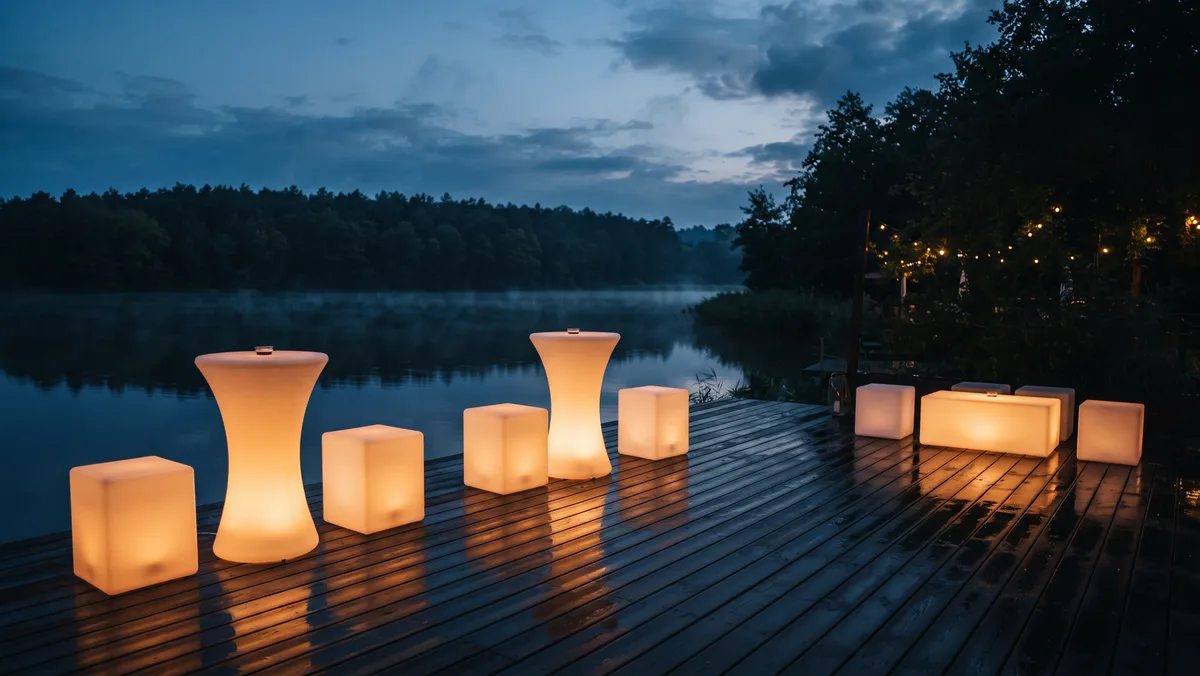
At an outdoor event the lighting rarely fails on brightness. It fails far more often because a shower comes at three in the afternoon, the wind gets up at eight in the evening, and by midnight it is ten degrees colder than anybody thought about at the morning site visit. Battery-powered furniture lit from within works exactly in this band: it is not street lighting but the light that marks out where it is worth stopping on a festival site, at a lakeside, in a garden or on a terrace. The question is never whether it is attractive but what it will take and where its limits are. In this article we go through the four factors that really count on an outdoor evening - water, wind, ground and battery - look at what should happen to the furniture after the event, and also say when there is no avoiding running power to the site. Every figure in this article comes from our own product pages: IP rating, weight, battery capacity, gross price.
What IP54 means in practice - and what it does not
Across our entire illuminated furniture range, on all 45 pieces and 23 ready-made sets, the data sheet gives the same value: IP54. The two digits of an IP code are the results of two separate tests. The first is the 5: the body is dust-protected, meaning dust can get in but not enough to interfere with operation - this is not a dust-tight seal, which would be a 6. The second is the 4: the enclosure is protected against splashing water from every direction. Translated into practice, that means a summer shower, morning dew, the sweep of a sprinkler, water dripping off a guest climbing out of the pool and a knocked-over glass will do it no harm. What it does not mean is that it can be immersed: that would be IPx7, and we have no such figure. Thrown into a pool, a piece will be damaged. It will not take a pressure washer either, because that is the IPx5-IPx6 category for water jets. And it will not take a flooded area: do not plan a rest zone for a low-lying spot where water collects, because there the water does not splash, it stands. The logic of the IP code is the same as with displays, only the requirement is higher there.
Battery operation: how long it lasts, and what runs out first
Most of the pieces run on a 5200 mAh lithium-ion battery: the round cocktail table, the dining table and most of the armchairs and sofas. The smaller, lighter items have 2600 mAh - the 40 × 40 × 40 cm cube stool and the bar stool with a backrest, for example. The bar counters have a higher capacity at 5600 mAh, and the large sofas and the multi-element counters work with two batteries. The manufacturer states the same running time for all of them: 6-8 hours, depending on the colour chosen. A programme starting at 6 pm therefore reaches its end somewhere between midnight and two in the morning, so the classic evening slot comes out of one charge. What the manufacturer does not state is the charging time - which is why it is not worth planning on a recharge during the event; the place for charging is the day before. On a cool evening, count on the lower end of the range, six hours, rather than the upper one: the data sheet states no separate running time for cold conditions either, and a conservative estimate is cheaper than a dark zone at midnight. At a multi-day event the days cannot be strung together: charging is needed every evening.
Wind: the risk is not getting wet but tipping over
This is worth saying plainly: there is no wind-resistance figure on our product data sheets, so we do not quote a number in km/h, and if somebody does quote one, ask them where they got it. What you can work with is the weight and the footprint, because both of those are published for every piece. The lightest items are the Ø63 × 56 cm light coffee table at 3.5 kg, the 60 × 60 × 20 cm low table at 4 kg and the cube stool at 4.84 kg. These can move in a strong gust, so they belong under a marquee, against a wall or in a sheltered corner. The most vulnerable combination is tall and light: the narrow Ø58 × 110 cm cocktail table is only 8 kg, but its centre of gravity is almost a metre up, on a small base. That is the one to bring in first when the wind gets up. The heavy pieces - the 35 kg cushioned sofa, the 34 kg 150 cm bar counter, the 22 kg relax lounger - will not fly away, but if they do go over the damage is greater. So never put a loaded counter on a slope. And do not put a weight on top of the surface: that raises the centre of gravity, achieving exactly the opposite.
Ground: grass, gravel, sand or a timber deck
Outdoors it is the ground that decides whether a piece stands stably, and this is the point where morning planning tends to come unstuck. On fresh, soft or rain-soaked lawn, high tables with narrow bases sink in, and the sinking is never even, so they start to wobble: here you need a pallet, a floor panel or a paving slab underneath, or choose a model with a wide base and a large bearing surface in the first place. On gravel and shingle it is the other way round - stability is fine, but the underside of the polyethylene body gets scratched, so carry the pieces rather than dragging them. On sand, that is at a beach festival or a riverside, the flat items with a large base behave best: the 60 × 60 × 20 cm low table does not tip even on an uneven surface at its twenty-centimetre height, and it suits a group sitting on the ground. Do not plan counters and high tables for a sloping area. And on wet terrace paving, put the larger pieces in place once and do not move them during the programme: pushing a 34 kg counter across slippery stone is a two-person operation. Always walk the marked-out spot before setting up.
Damp, dew and the switch to the evening chill
The evening drop in temperature is hard on the guests, not on the furniture - but indirectly it is still a planning question, because from the moment it turns cool everyone goes where they can sit and lean. That is why it pays not to spread the zones evenly: for the late evening hours, two or three denser islands close together work better than six scattered points. As for damp, the polyethylene body is a sealed, continuous surface with no fabric cover - and that is the difference that really shows in the morning. The dew is not absorbed and the surface does not stay a wet seat, as it certainly would on an upholstered piece: a wipe with a damp cloth and it is ready for opening the next day. Wine, coffee and grease are the same story; they leave no stain either. According to the specification the material is impact- and UV-resistant and also withstands extreme temperatures, so the sun over a long weekend will not fade it. Keep one thing in mind for a damp evening, though: wet paving is slippery, and lighting the walkways and the steps is not this furniture's job.
What an outdoor zone costs for a day
Working out the daily hire rate is simple: 20 per cent of the product's gross sale price. The 40 × 40 × 40 cm cube stool, with a list price of HUF 45,000 incl. VAT, is therefore HUF 9,000 incl. VAT a day; the 60 × 60 × 20 cm low table is HUF 14,000 incl. VAT from HUF 70,000 incl. VAT; the narrow Ø58 × 110 cm cocktail table is HUF 21,800 incl. VAT from HUF 109,000 incl. VAT; and the round Ø80 × 110 cm cocktail table is HUF 44,000 incl. VAT from HUF 220,000 incl. VAT. A ready-made set is better value than this, because the set list price is 95 per cent of the sum of its members. The chill set of four cube stools and a low table is HUF 237,500 incl. VAT, so HUF 47,500 incl. VAT a day - the same five pieces hired separately would be HUF 50,000 a day, a difference of HUF 2,500, all incl. VAT. The poolside set of two relax loungers and a low table is HUF 807,500 incl. VAT, HUF 161,500 incl. VAT a day. This article does not settle delivery charges, deposits or a minimum hire period: those are agreed in the confirmation, and for several days and larger configurations an individual, itemised quotation is issued.
After the event: derig, cleaning, charging
The derig is quick if the zones are numbered on the packing list, because then there is no guessing halfway back about what belongs where. For assigning people, weight decides: items between 3.5 and 8 kg can be carried by one person, even two at a time, while those above 20 kg - the relax lounger, the bar counters, the large sofas - need two. For cleaning, the sealed polyethylene surface is the great advantage: a damp cloth and a neutral cleaner, and a set is done in five minutes. What not to do: do not go at it with a pressure washer, because IP54 protects against splashing water, not against a jet. And do not stick sponsor decals or lettering onto the pieces - the surface can be damaged when they are removed, and besides, the body lights from within, so a decal would mask out a band as a dark patch. Brand marking needs a separate carrier beside the zone. Charging is routine at the end of every event or trading day: several pieces can go on the mains from one extension lead, and the point is that everything is full for the next opening.
When power does have to be run to the site
There are three cases in which the battery-powered route is not enough. The first is the walking surface: illuminated furniture is mood lighting, not street lighting, so it does not substitute for lighting the approach route, the steps and the escape route - that has to be solved by the venue's lighting plan, with the furniture working alongside it. The second is brand content. If a logo, lettering, video or a live picture has to be shown, that needs a display: our panel available for hire works with a 64 × 192 cm portrait image surface, one panel weighs 45 kg, its power draw is 0.8 kW, and it runs from a mains connection - there is no battery-powered version here. Under open sky the outdoor, cabinet-built P2.5 or P3 version is the right one, at 4500-5000 nits, because a 700-800 nit indoor panel washes out in daylight. The third is a long programme: if the evening runs until dawn and there are no charged spare pieces, then a socket is needed for charging. If you think these three through in advance, no cable really is left in the guest area on the furniture's account - and that was the whole point.
A few questions and you get the recommended pixel pitch, the size and an indicative price.
Start the configurator →


