LED furniture maintenance: cleaning, batteries, storage
How to keep illuminated event furniture in service: what to wipe polyethylene with, how to handle the batteries, and what to check after every event.
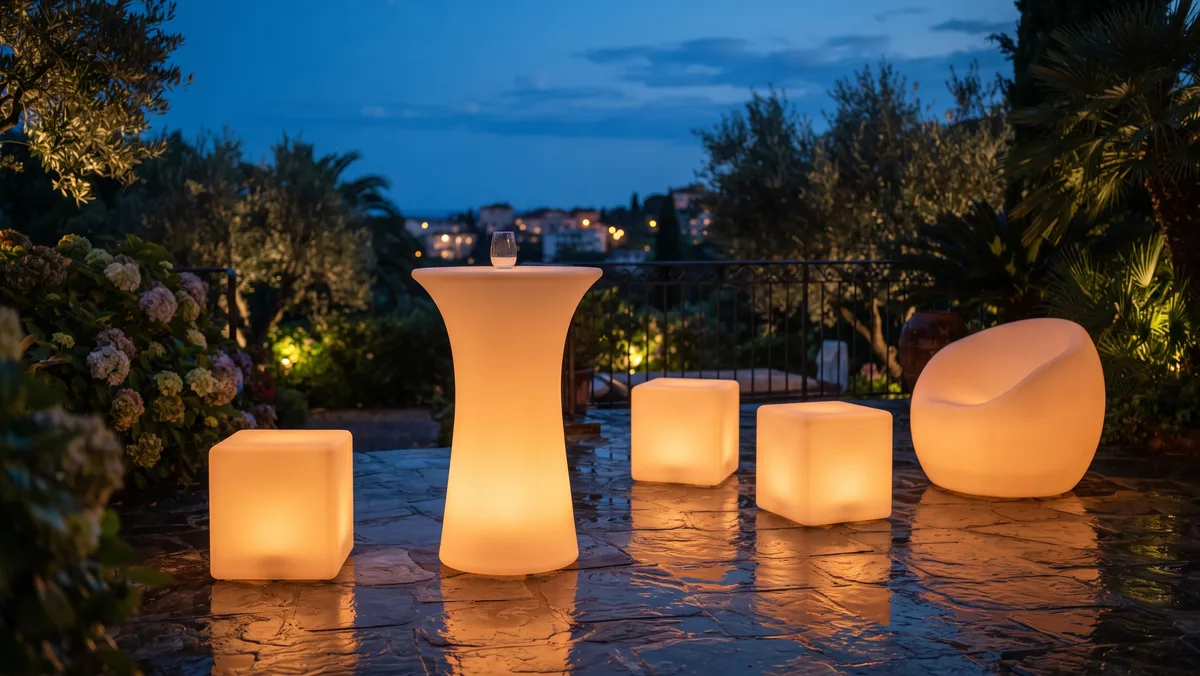
Running illuminated event furniture is significantly simpler than running upholstered furniture because there is no fabric on it: nothing to have cleaned, no seam for crumbs to fall into, and no cover to be stained by suncream or spilt wine. That does not make it maintenance-free, though. There are three points where a set can wear out sooner than it should: the surface, if it is cleaned with the wrong product; the battery, if it is charged hastily and irregularly; and the accessories, if there is no record of them. This guide goes through all three, built on the real data of our own product line - the 45 battery-powered pieces and 23 ready-made sets that we sell and also hire out. Anyone hiring does not have to do most of this, but it is worth knowing what happens to the pieces between two events, because that is what determines the condition your order arrives in.
What to wipe polyethylene with, and what not to
Proper cleaning means a damp cloth and a neutral cleaner - that is all. The body is polyethylene, a moulded piece with a sealed, smooth surface that does not absorb wine, coffee, grease or suncream, so a stain cannot settle on it. Wiping down a lounge zone of ten coffee tables therefore takes ten minutes, not an hour, and on the bar counter there is no grout line for syrup to stick in. What we do not recommend: scouring pads, abrasive paste, solvent-based cleaners. Not because the body will disintegrate - but because on illuminated furniture the state of the surface is also an optical question. A matt, scratched, micro-crazed surface scatters the light coming from inside differently from a smooth one, and that shows when the piece is switched on, making an otherwise sound item look blotchy or hazy. For the same reason, do not use a pressure washer either: water under pressure gets into places splashing water does not, and works on the surface at the same time. Drink spills are best wiped off the same day, during the derig, because a sugary residue comes off with a hand and lukewarm water while it is fresh, whereas rubbing the same thing off dry with a cloth is exactly what damages the surface.
What IP54 means in practice: what it takes and what it does not
The entire furniture line is IP54 rated. In practice that means a summer shower, morning dew, a spilt glass and the water running off a guest climbing out of the pool will do no harm to a piece, so there is no need to carry fifty chairs indoors in a panic when it starts to rain, and no need to pack the terrace away every evening. A relax lounger placed by the pool takes chlorinated water and suncream too - precisely the two things that finish off a fabric-covered sun lounger within a few seasons. What IP54 does not mean: it is not submersion-proof. It must not be put into water, thrown into a pool or held under a sustained jet. Equally, standing water on a piece is not a good idea: with the standing table with an ice bucket, for instance, make emptying and wiping out the ice bucket part of the closing routine, so that meltwater does not sit in it until the next event. Dryness matters for charging too: the furniture works outdoors, but charging should always take place under cover, in a dry place.
Batteries: it is the routine that counts, not a trick
The range works with 2600, 5200 and 5600 mAh cells, and two of them in the larger pieces: two 5200 mAh cells in the 190 cm wave-lined sofa, a 5600 mAh cell in the 150 cm bar counter, and two of the same in the 102 cm counter elements. The manufacturer states 6-8 hours of light for every piece, depending on the colour chosen - that carries an evening programme starting at 6 pm through to the end. Charging time, on the other hand, is not stated by the manufacturer, and we will not invent a figure for it. From that follows the one serious operating rule: plan the charging for the day before the event, not for its final hours, and do not count on recharging during the event at all. If you are working with several pieces, put it on an operational footing: designate one charging point with a power strip in the store, and have the whole stock always come back to the same place. With an eight-seat dinner set, for example, you have ten batteries to manage - one 5200 mAh cell in each of two tables and one 2600 mAh cell in each of eight chairs, 31,200 mAh in all - and if those are put away in ten different places, one of them will certainly be missed. How many charging cycles a cell will take is not stated by the manufacturer, so we do not promise a service life for it either: treat it as a wear part, and do not leave finding out until the last possible moment.
Winter storage: dry, frost-free, not at the bottom of the garden
The body also withstands extreme temperatures, so the furniture itself is not ruined by spending a cold night outside - it can stay out on the terrace for a whole season. Winter is a different case, though, and not because of the polyethylene: there is electronics and a battery in the furniture, and over months of standing idle that is the weak point, not the shell. At the end of the season it is therefore worth bringing the stock into a covered, dry, frost-free place, and not starting the storage period with a completely flat battery. If the store is left untouched for months, put a recurring reminder in the calendar to put the pieces on charge from time to time - that is a few hours of work over a season, and it prevents exactly the situation where you discover in spring which piece will not wake up. Two things matter when packing: do not stack the pieces on top of one another, because this is not stackable conference furniture, and allow extra room for the curved shapes. The petals of the flower-shaped table and the wave-lined sofas do not sit flush against each other, and packing them takes a few centimetres more than the overall dimensions promise.
Scratches and UV fading: what actually wears
There is no need to worry about fading: the body is UV-resistant polyethylene, summer sun does not take its colour, and that is one reason the pieces can spend a whole season outside on a terrace or beside a pool. Scratching is a real risk, however, only it does not happen where you would expect. It is not the guest who scratches the furniture - the loading does. The 110 cm high cocktail table can be transported lying down, but the top then has to be protected so the load does not rub it; and the underside of a sofa element slid along the floor will mark itself in a single run. The remedy is cheap: moving blankets between the pieces, and carry the heavier elements with two people rather than dragging them. The weight figures set the threshold here - the lightest coffee table is 3.5 kg and the 40 cm cube stool 4.84 kg, which anybody can carry one-handed, whereas the 34 kg bar counter or the 35 kg cushioned sofa is a two-person item. A scratch is more of a nuisance here than on conventional furniture because the light breaks at damage to an illuminated body, and switched on, even the slightest mark is drawn out. Impact is nothing to fear, incidentally: the body is impact-resistant and the load capacity is 150-200 kg, so an adult guest, or a wedding party climbing on for a photograph, is no problem.
Remote controls and chargers: the smallest part takes the most time
Experience says that with an event stock it is not the furniture that goes missing but the small items that go with it. The colour is switched across all seven shades by remote control, and a single remote is enough for the whole stock - a great advantage at an event, because the room turns colour all at once, but in the store that is exactly the trap: if one remote handles everything, it is easy to believe it does not matter if one or two do not come back. The same goes for the chargers. Keep an item-level record by product code: the furniture's product code, next to it how many chargers and how many remotes belong to it, and which box they are in. Every piece has a product code, so there is no need to invent an identifier of your own - the cube stool is D104B, the narrow cocktail table C116, the 150 cm bar counter C180, and so on. Accessories should travel separately in a lockable box, not loose among the furniture, and at the derig they should be counted back in the same way they went out. A spare set of batteries for the remotes also costs less than an evening on which the colour cannot be changed.
The seven-point check after every event
It is worth running the same short round at the derig, always in the same order. One: switch on every piece and cycle through the colours with the remote - that shows immediately if a segment fails to light. Two: wipe the surfaces down on site or at least the same day, before the drink stain dries on. Three: empty and wipe out the storage compartments, the ice bucket and the lower and upper shelves of the counters, so that no water or rubbish is left in them. Four: look over the edges and corners for cracks, scratches and impact marks - the corner element of the bar counter and the inner curve of the lounge corner are the busiest points, and wear appears there first. Five: every piece goes on charge at the designated charging point, even if the next event is weeks away. Six: count the remotes and chargers back in against the record. Seven: write down anything you noticed - which piece lit more weakly, which one has a mark - because with a stock, faults only form a pattern after three or four events, and you will only spot it from written notes.
If you are hiring, this list is not yours
Only one line of all this stays with the hirer: the furniture has to be switched on, the colour can be set with the remote, and there is nothing else to do. We do not provide an operator on site, but there is nothing to operate either - switching on is a single button press that anyone on the team can manage. Charging, cleaning, end-of-season storage and the fate of the batteries are our job when you hire, and that is precisely one of the real values of hiring, not just the smaller one-off outlay. If something is damaged at the event, we set out how responsibility works in the confirmation and in the hire terms before you sign anything. For anyone buying for their own venue, though - a restaurant, a terrace, an events house - this list becomes part of daily operation, and it has to go into the calculation as well: the time that charging, wiping and storage take is a cost just as the purchase price is.
A few questions and you get the recommended pixel pitch, the size and an indicative price.
Start the configurator →


