Party trends 2026 - garden parties, house parties, evening spaces
Illuminated furniture, a garden split into zones, coloured light and cable-free solutions: what has changed in planning smaller private events.
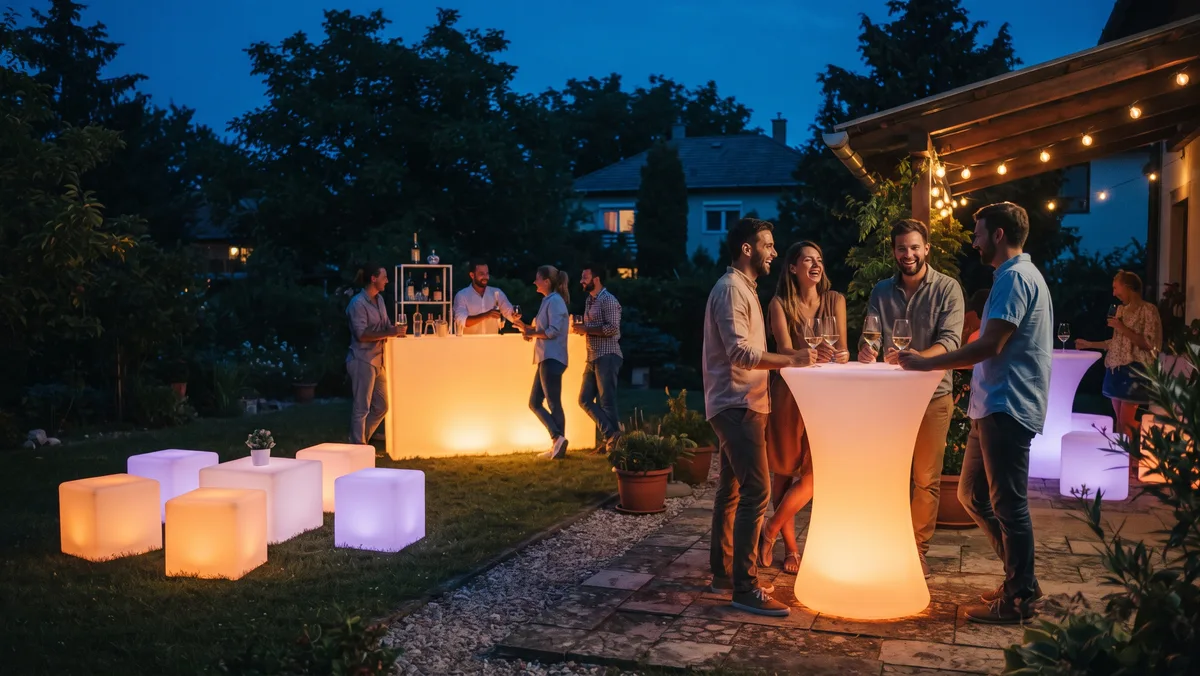
At a garden birthday or a house party the question is not whether the furniture fits, but whether the space stays usable in the evening. After eight o'clock the back of the garden falls dark and the company automatically migrates into the kitchen, where the lights are on. Private-event enquiries over recent seasons show that the centre of gravity in planning has moved to exactly this point: less decoration, more attention to where people can stand, sit and put a glass down in the evening. The points below gather that change, and what it means translated to a garden party of fifteen to thirty people or a house party on a terrace.
Fewer guests, a denser atmosphere
At private events the typical request today is for few guests but a venue that looks properly done. That carries one important consequence: placing a few pieces well is worth more than having many pieces. In a private garden the recurring mistake is that the furniture gathers around the house while the middle and the back of the lawn stay empty - yet bright points only work if the guest sets off towards them. A table at the edge of the terrace, another under the tree and a seating corner at the bottom of the garden already spread the company out by themselves. When sizing, watch the walkable lanes. On an average 150 square metre lawn five or six furniture points are the upper limit; above that the garden becomes crowded and the light loses its effect too, because there is nothing for it to stand out against. A good proportion is a fifth to a third of the area furnished and the rest left walkable. If the garden is long and narrow, put two points at the far end so that there is a reason to walk that way. At a house party on a terrace the same rule applies in miniature: a high table by the railing, a low seating group at the other end, and the strip between them left clear for movement.
Illuminated furniture instead of festoon lighting
Garden mood lighting long meant festoon lights: they need an outdoor socket, something to hang them from, and an extension lead through the terrace door. That is why many private events have turned over recent seasons to illuminated furniture, where the furniture is itself the light source. There is no separate decoration to hire for the sake of the light, and nothing to adapt to the garden's existing fittings. The pieces run on battery, so they go where the company will be, not where the socket is. The body is polyethylene, impact- and UV-resistant and IP54 rated, so a summer shower, the sprinkler and a spilt drink will not put a piece out of action. The surface wipes clean, so barbecue grease and spilt wine leave no lasting mark either - it takes a damp cloth, not an upholstery cleaner. After a house party that is no small thing, because the cleaning is usually the next day's job. It is worth seeing what this furniture replaces: not one item of decoration but two. There is no separate light source needed for the zone, and no separate table or seat needed under the light, because the same piece does both. At a small event, where most of the budget goes on food and drink, that consolidation is what counts most.
A space split into zones: drinks counter, lounge, dance floor
The biggest change of approach is that the garden or the terrace is no longer a single space but three or four separate functions. The most common division: a drinks counter where the serving happens, two or three high tables as standing points, one or two conversation corners with a coffee table, and a patch left clear for dancing. The drinks counter has a role of its own because it gathers the glasses, the ice and the accessories in one place, and so frees up the kitchen. Putting a corner element next to a 150 cm counter element with lower storage makes an L-shaped service point, with the glassware under the counter. In the lounge zone a suite - a sofa, or two armchairs and a coffee table - seats 3-5 guests, and typically a third of the company sits down at any one time. Do not furnish the dance area: a few stools around its edge are enough, because they mark the boundary and at the same time give anyone catching their breath somewhere to sit.
Coloured light - and when it becomes too much
The colour switches by remote control between seven shades, and in practice that allows two things. One is for the light to follow the course of the party: a warm, calm shade during dinner and something livelier later, without anyone having to touch lighting equipment. The other is for the zones to have separate colours, so that the lounge corner and the drinks counter are distinct from a distance. There is a limit worth taking seriously, though: in a small garden a multi-coloured overall picture makes the space restless. On an average lawn it is better to hold a single shade throughout and work with the placement of the furniture points instead. Colouring by zone comes into its own when there are at least three or four clearly separate areas. With children in the party, incidentally, changing the colours is entertainment in itself and the remote control can safely be left to them - there is nothing on the furniture that can be knocked out of adjustment, and any setting can be undone. For photographs, though, bear in mind that saturated colours come out stronger on a phone camera than to the naked eye: if you also want usable pictures of the guests, a shade close to warm white is kinder than deep blue or red.
Cable-free, even at the bottom of the garden
Cable-free operation is one of the strongest arguments at private events, and not for aesthetic reasons. In a garden an extension lead always brings the same problems: somebody has to throw it through the terrace door, it gets trapped in the gate, it gets wet in the rain, and in the end somebody trips over it. With children present this is the most frequent source of accidents, and since with illuminated furniture no cable crosses the garden at all, that consideration disappears by itself. In exchange, charging has to be planned in. One charge gives 6-8 hours of light depending on the colour, which covers an evening comfortably, but if you switch on in the afternoon and want light after midnight it will run out towards the end. Charging is best done the day before the event, in the garage or the utility room, rather than counting on a recharge during the party. Moving the pieces takes no preparation either: when everything is rearranged after dinner the dining chairs form a circle, the coffee table moves to the middle, and their light travels with them.
Poolside and outdoor use in the evening
The paving beside the pool is the best place for this kind of furniture, because the water reflects the light and that makes even a smaller garden look bigger. Two relax loungers and a low side table at the water's edge already set the mood by themselves, with no festoon lighting and no floodlight off the house wall. Moisture is a fair question here: the body is protected against splashing water at IP54, so water dripping off a guest climbing out, the sprinkler and a summer shower will do it no harm. What you must not do is put it into the water. This is not floating decoration; thrown into a pool it will be damaged, so plan it for the poolside, ideally at least an arm's length from the edge. On slippery, wet paving it is worth putting the larger pieces in place once and not moving them during the party. On a lawn the ground decides: on level, well-trodden grass everything stands firm, but on freshly watered or rain-soaked ground the heavier pieces sink in - in that case look for a firmer spot or put a paving slab underneath.
What an evening configuration costs
For hire there is a single rule: one day costs 20 per cent of the item's gross sale price, and that applies across the whole range. The entry item is the 40 cm cube stool, which at HUF 45,000 incl. VAT is HUF 9,000 for a day. A Ø80 cm, 110 cm high cocktail table is HUF 44,000 out of HUF 220,000 incl. VAT, a bar stool with a backrest HUF 19,800 out of HUF 99,000, a 150 cm bar counter with lower storage HUF 58,000 out of HUF 290,000, and the 195 cm relax lounger HUF 78,000 out of HUF 390,000. The amounts include VAT and are indicative. Ready-made sets work out better because their price is 95 per cent of the list prices of their members, and that carries into the daily rate too: the daily rate for the chill set of four cube stools and a coffee table is HUF 47,500 incl. VAT, whereas the same five pieces hired separately come to HUF 50,000. With the cocktail set - a Ø80 table with four compact bar stools - HUF 98,800 incl. VAT stands against HUF 104,000 hired separately. We do not blindly multiply up for several days: for a longer period we give an itemised, individual quotation.
What to think through in advance
Three things scupper an otherwise well-planned garden party, and all three can be prevented. The first is getting in: a private event rarely asks for more than ten to fifteen pieces, but reaching the site is harder than in an event hall - a narrow gate, steps, a gravel approach, sometimes a route that leads only through the house. It is the size of the largest items that sets the limit, not their weight, so it is worth measuring the gate width. The second is timing: the 6-8 hour running time is for one evening, not for a party running from afternoon to dawn. The third is the effect indoors - the same piece goes outdoors and onto an enclosed terrace, but under strong artificial lighting the light looks fainter, so it is worth dimming the room when you switch the furniture on. Behind a glass wall, on the other hand, the reflection doubles the effect, which is striking in a small space. And before returning it, a wipe-down is all that is needed; there is nothing else for you to do.
A few questions and you get the recommended pixel pitch, the size and an indicative price.
Start the configurator →


