Event trends 2026 - what has changed in event planning
Experience-led spaces, photogenic points, lighting split into zones, modular furniture, hire instead of purchase and ever shorter build-up windows.
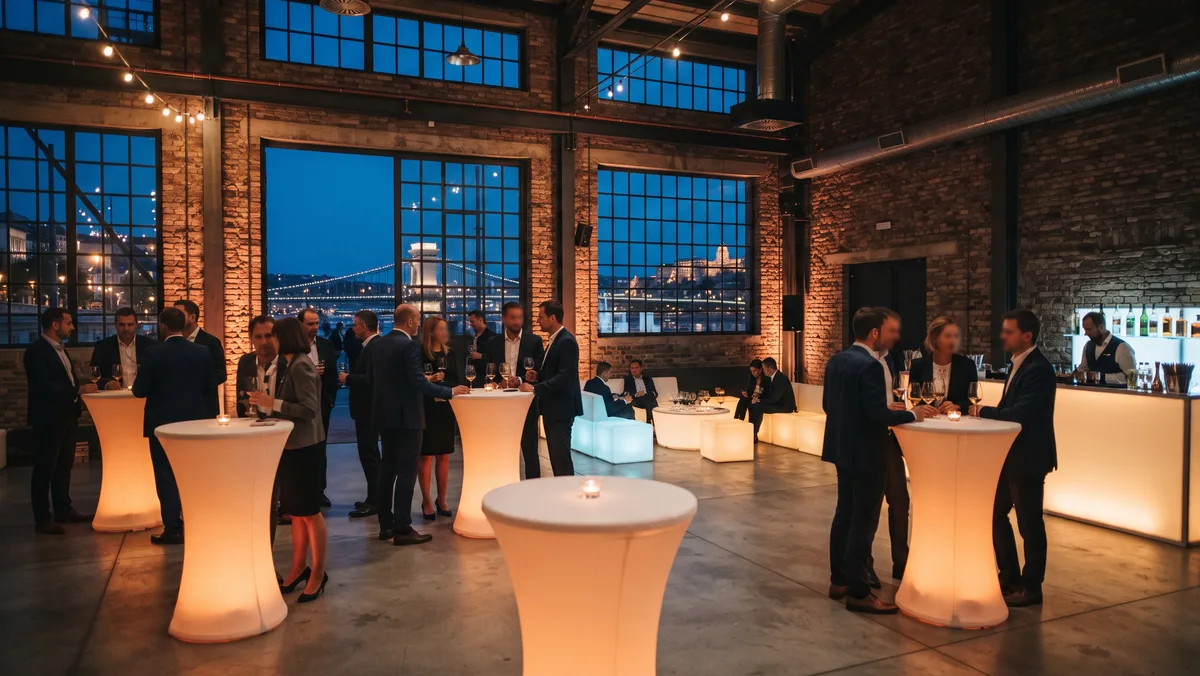
Over the past two years it is not the programmes that have changed in event planning, but where the budget and the planning time go. In more and more enquiries it turns out that the act and the menu are already settled, and the open question is the space: what the venue looks like after dark, where the guest will stop, and what ends up in the photographs. The points below gather what we see in our own hire and sales enquiries in 2026 - not from a survey, but from what organisers ask us for and what they ask back. Alongside each trend we have set out the practical consequence too: what it means for the furniture, for the build-up and for the budget.
The experience lives in the space, not in the programme
Five years ago the main question at a corporate evening was who would be performing. Today it is where the guest will stop. The difference is practical: the act takes forty minutes of the programme, whereas the space accompanies the whole evening, and it is the space that decides whether the guest talks to people or looks at their phone. Furniture here is not scenery but traffic management. Three or four people gather around a 110 cm high standing table, and that is exactly the group size where everyone can still hear one another. If the tables go against the walls, the middle of the room empties; if they stand too close together, the guest gets stuck in the first circle they drifted into - one and a half to two metres of clear space is needed between two tables. The same sizing holds as you scale up. A year-end party for 120 people does not need thirty-five high tables but eighteen to twenty-two, because a third of the company is on the move at any time. And the furnished proportion should not go above thirty per cent of the floor area, or what grows is not the atmosphere but the crush.
Photogenic spaces: the guest's phone is the most important media surface
Organisers today almost always ask what the point at the venue will be that the guest photographs. This is not vanity: the afterlife of an event consists largely of what the participants share of their own accord, and it does not take a purpose-built photo wall - one object that looks good in itself after dark is enough. That is part of why illuminated furniture has become a frequent request. A flower-shaped table, a wave-lined sofa or an L-shaped illuminated bar counter turns into a photo point by itself in a dimly lit room, because the light comes out of the object rather than being thrown onto it. And the guest does not pose in front of a backdrop, but photographs the thing they are using at the time. One point is worth settling in advance with the marketing colleague, though: this is not a display. It has no image surface, it carries no logo, lettering or moving image, and its colour cannot be mixed to an arbitrary brand shade. If brand content also has to be shown, that calls for a LED wall or a LED poster above or behind the furniture: the image surface carries the message, the furniture organises the space beneath it.
Lighting and mood design split into zones
Mood lighting used to come from the ceiling and was set up by a lighting technician. Current enquiries instead ask for the different parts of the space to look different: the reception zone, the dinner tables and the dance floor should each have their own mood, ideally without anyone having to go to a control desk in the middle of the event. That is why lighting is increasingly being moved into the furniture itself. The colour of the illuminated pieces can be switched by remote control between seven shades, so the light can be warm and calm during dinner and different once the party starts - with no decorator and no further hired props. A separate colour per zone brings a practical benefit too: if the VIP area glows in a different colour from the public space, the boundary is visible from a distance and fewer barriers are needed, because the guest instinctively stays in the area that matches their own colour. At a smaller venue, however, it is worth thinking the other way round. In a narrow loft or an average-sized garden a multi-coloured overall picture makes the space restless; there it is better to hold a single shade throughout.
Modular, mobile, cable-free furniture
Rigid suites delivered in one piece have been replaced by furniture assembled from elements. The request typically sounds like this: the same stock should serve both a long, narrow foyer and a square room. That can be solved with modules - straight and corner elements make up a seating corner fitted to the venue's floor plan, and the counter elements make an L- or U-shaped service point, depending on which side the bartender stands and which direction the guests arrive from. The other half of mobility is power. Battery-powered pieces have spread at events because the furniture goes where the flow of guests requires, not where there is a socket. No generator is needed at the bottom of the garden, there is no cable ramp at floor level, and there is nothing to trip over beside the dance floor. The limit on moving things is weight and size: the lightest coffee table is 3.5 kg, the largest sofa 35 kg. One person can carry the smaller pieces and two are needed for the large ones, and in transport the bottleneck is usually not the weight but the space the tops and the sofas take up.
Sustainability: hire instead of purchase
At events, sustainability rarely comes up as a matter of principle. It shows far more in the fact that nobody wants to store furniture for six months that gets used once a year. For a wedding, a corporate year-end party or a product launch, hire is simply less of a burden: there is no storage, no charging between two events, and it is not the organiser's problem what happens to the furniture after the season. The same logic works in hospitality. The terrace season runs from May to September, after which the stock takes up space for six months, so many bring it in for the season rather than buying it. A trial period is common too: someone asks for two or three tables for the most visible part of the terrace, watches what the regulars make of them and how much attention they take after closing, and only then decides about buying. The dividing line is roughly where the frequency of use tips over. If your own venue would use them many times a year, after a handful of occasions purchase works out better - the full range is listed with published list prices, and in a ready-made set it can be ordered with a 5% discount.
Shorter build-up, a narrower window on site
What has visibly shrunk in recent years is the time allowed for build-up. At more and more venues there is a single half-day for the build, a designated slot for vehicle access, and a narrow window for the derig after closing - and this comes from the venues' house rules, not from any carelessness on the organiser's part. It has rearranged what is worth choosing as furniture. Battery-powered pieces that need no rigging have come to the fore because there is nothing to screw together, wire up or run cables to: unpack, push into place, switch on. For the same reason rearranging during the programme is quick: if the evening moves from the formal part to informal conversation, the pieces can be brought in within minutes rather than quarter-hours. Two things are worth checking in advance. One is the route in - the internal dimensions of the goods lift and the width of the hall door often set the limit with larger counters and sofas, not their weight. The other is how the loads are divided up: if one run fills a whole zone, you are not left with a half-finished island in the middle of the room even if the programme slips or it starts to rain.
What this means in forints
For illuminated furniture hire we have a single rule: one day costs 20 per cent of the item's gross sale price. Any item can be worked out from that. A Ø80 cm, 110 cm high cocktail table is HUF 220,000 incl. VAT, so a day is HUF 44,000; a bar stool with a backrest at HUF 99,000 is HUF 19,800; a 150 cm bar counter with lower storage is HUF 58,000 out of HUF 290,000. The cheapest way in is the 40 cm cube stool: at HUF 45,000 incl. VAT it is HUF 9,000 for a day. The amounts include VAT and are indicative. Ready-made sets work out better because their price is 95 per cent of the list prices of their members, and that comes through in the daily rate too. The daily rate for the chill set of four cube stools and a coffee table is HUF 47,500 incl. VAT, whereas the same five pieces hired separately come to HUF 50,000 - a difference of HUF 2,500 a day. With the cocktail set, where a Ø80 table comes with four compact bar stools, HUF 98,800 incl. VAT stands against HUF 104,000 hired separately. We do not multiply up for several days: blindly multiplying the daily rate would give an unrealistic figure, so for a longer period and a larger configuration we give an itemised, individual quotation.
What these trends do not solve
It is worth stating the limits too, because disappointment always arises where somebody expected more. Illuminated furniture is not a screen: it shows no logo, no product list, no video, nothing can be projected onto it, and out of the seven fixed shades you can get close to a brand colour but not match it exactly. The second limit is running time. One charge gives 6-8 hours of light depending on the colour, which carries an evening programme through, but it will not link a gala running until dawn or the consecutive days of a three-day fair. So plan the charging for the day before the event rather than for its final hours, and if the programme is long, either work with spare pieces or accept that the light will run out towards the end - the furniture remains usable even then, only dark. The third is physical reality: the large elements need two people, and a narrow gate, a staircase and a gravel approach have held up more events than any technical question. That is solved by a site visit beforehand, not by the choice of furniture. And the fourth is the venue's house rules: many hotels and conference centres specify what may stand on the floor and by which route it may be brought in, so it is worth asking the venue contact about this even before the request goes in.
A few questions and you get the recommended pixel pitch, the size and an indicative price.
Start the configurator →


